

Unicorn Court, Weobley, County of Herefordshire
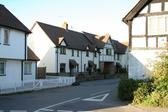
Timber-framing in a new development in Weobley
©Bob Edwards

Region: West Midlands

Unitary Authority: Herefordshire, County of

Summary: An affordable housing scheme in the village of Weobley, Herefordshire. The development provides a number of houses in a highly sensitive historic area famous for its timber-framed building tradition.

Description:

Weobley is famous as a ‘black and white’ village and forms part of a tourist route on the basis of its timber-framed buildings.  Exposed framing is the most notable material but render – either infill panels or over the framing - is also characteristic.  At the heart of the village is a wide market street with smaller streets leading away.  Unicorn Court lies on the High Street, which includes a number of timber-framed buildings.  It occupies a large plot with a wide frontage on a prominent route close to the edge of the historic village core.

Issue: The development needed to successfully fit into a village with a strong historic character.  The large street frontage meant the scheme would be highly visible and had to respect the existing building line and sense of enclosure whilst also allowing development within the rear plot.
Strategy: The front range of Unicorn Court is mainly render but employs timber-framing in two bays – a projecting, gabled bay which provides an entrance to the rear of the site and a further bay to one side.  Whilst this is a relatively long range it has been broken up by a change in ridge and eaves height, irregular fenestration and the use of two gables to the street frontage.  The entrance to the rear also uses local red sandstone.
Outcome:

Unicorn Court shows how local characteristics can be reflected within a large range without having an overly complicated design.

Whilst traditional timber-framing may be a relatively expensive type of construction, the small area of framing is sufficient to link the new building within the historic streetscape.  Plain render – allowing cheaper blockwork walling - also fits comfortably within the street scene.

Are there aspects of the scheme that could be considered as being less successful?

The small gabled dormers that break the eaves line do not reflect the traditional building style in the village.

Keywords: DESIGN IN CONTEXT

What's New?

  • Britain was the world’s first industrial nation and has a wealth of industrial heritage but many industrial sites have been lost or are at risk due to functional redundancy. English Heritage's survey has shown that the percentage of listed industrial buildings at risk is three times greater than the national average for listed buildings at risk.
  • The value of a well managed, protected and appreciated historic environment to both our quality of life and to the economy is well established. Heritage tourism contributes £20.6 billion to GDP a year whilst research shows that 93% of people think that in improving their local place it is important to save heritage assets.